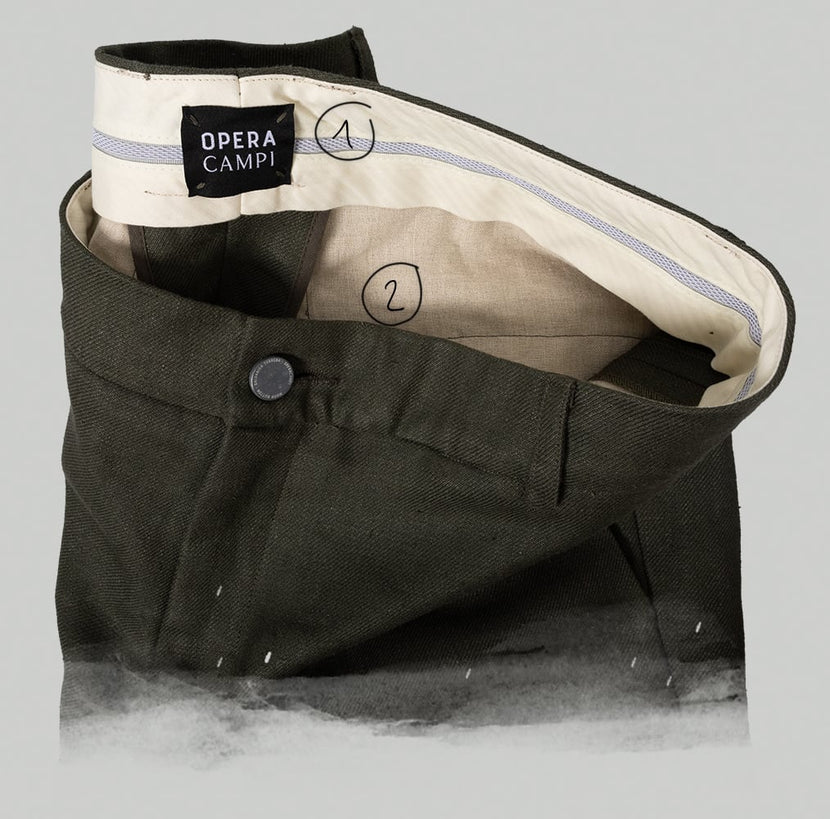
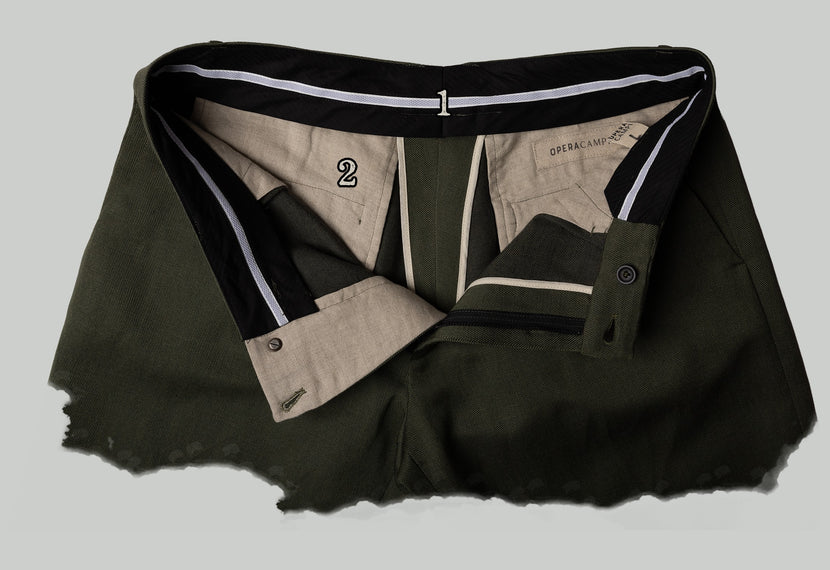
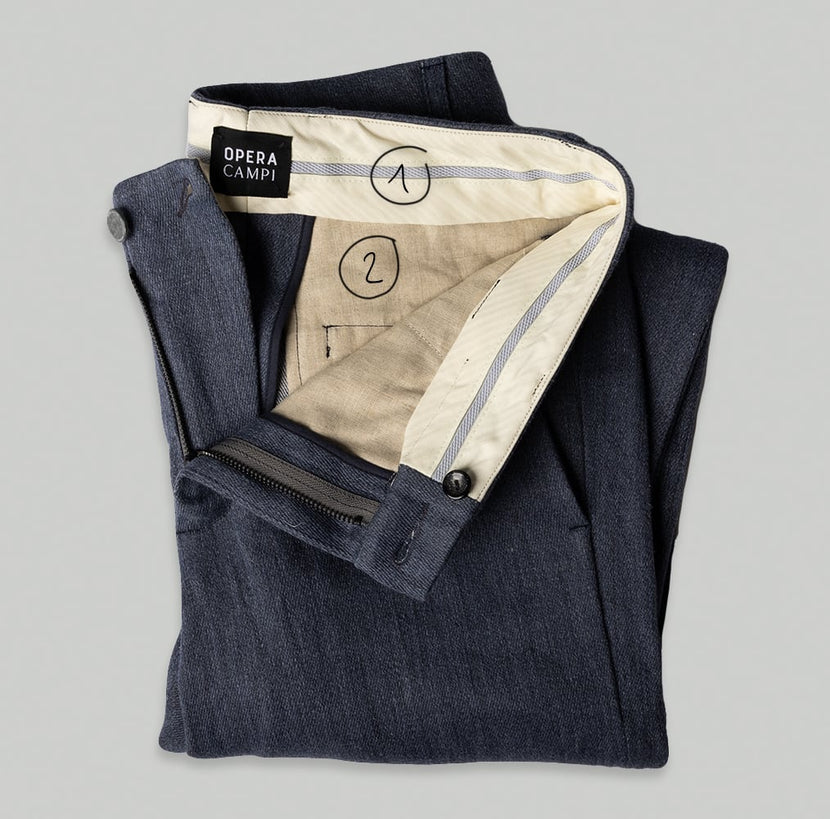
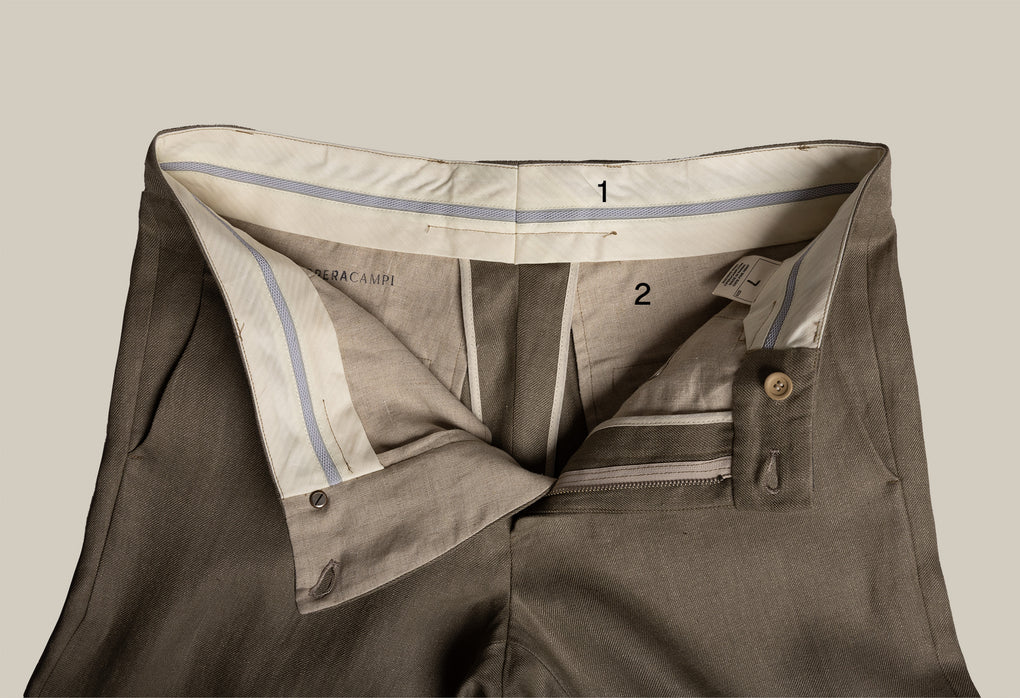
ここでは、サイズ選びをサポートするための高度なツールをご利用いただけます。または、AIアシスタントとチャットして、知りたいことを何でもお尋ねください。ご安心ください。しっかり学習させてありますし、役立つ情報はご注文時に保存されるため、必要に応じて創業者のAlbertoとBeatriceからご連絡する場合があります。私たちは小さなプロジェクトですが、テクノロジーは役立つと信じています。人によるサポートをご希望の場合は、いつでもメールでご連絡ください、またはサイト右下のチャットからお問い合わせください。
Size guide — how the system works
This page explains how Opera Campi suggests sizes. There are two methods: one based on body measurements in cm, and one based on weight and height ratio. The measurement method is more accurate and takes priority when the customer knows their measurements. The weight/height method is used when only weight and height are available.
Always select the table matching the product's fit: female products use the Female garment table and the Female allowances; male products use the Male garment table and the Male allowances. For unisex products, ask the customer which fit they prefer before choosing. The same body measurements produce different sizes on the two tables.
Method 1 — Body measurements
These tables show the sample garment measurements (in cm) for each size. These are the measurements of the finished garment, not the body. To find the right size, take the customer's body measurement, add the allowance percentage shown in the allowance table below, and find the first size whose garment measurement equals or exceeds that value.
Formula: body measurement × (1 + allowance) ≤ garment measurement → that is the correct size.
Example (male): chest = 92 cm, allowance = 7% → 92 × 1.07 = 98.44 cm → first size with chest ≥ 98.44 is S (100 cm) → suggest S.
Example (female): chest = 90 cm, allowance = 6% → 90 × 1.06 = 95.40 cm → first size with chest ≥ 95.40 is XS (96 cm) → suggest XS.
Which measurements apply to which garment
Do not mix upper-body and lower-body measurements. Using hips to size a sweater is the most common cause of an oversized suggestion.
| Garment type |
Measurements used |
Measurements ignored |
| Tops: sweaters, t-shirts, shirts, polos, jackets |
Chest (deciding), Shoulders (check only) |
Waist, Hips, Thigh |
| Bottoms: trousers, shorts, leggings |
Waist, Hips, Thigh |
Chest, Shoulders |
| Full-body: overalls, one-piece |
Chest, Waist, Hips, Thigh |
Shoulders |
Garment measurements — Female
Chest and Shoulders come from the female top block. Waist, Hips, Thigh, Hem and Inseam come from the female trouser block. Note that female hips and thigh are wider than the male block at the same nominal size — never size a female product against the male table.
| Size |
Chest (cm) |
Shoulders (cm) |
Waist (cm) |
Hips (cm) |
Thigh (cm) |
Hem (cm) |
Inseam (cm) |
| XXS |
92 |
39 |
72 |
96 |
60 |
25.5 |
78 |
| XS |
96 |
40 |
76 |
100 |
62 |
26.5 |
78 |
| S |
100 |
41 |
80 |
104 |
64 |
27.5 |
78 |
| M |
104 |
42 |
84 |
108 |
67 |
29 |
78 |
| L |
108 |
43 |
88 |
112 |
70 |
30.5 |
78 |
| XL |
112 |
44 |
92 |
116 |
73 |
32 |
78 |
| XXL |
116 |
45 |
96 |
120 |
76 |
33.5 |
78 |
| XXXL |
120 |
46 |
100 |
124 |
79 |
35 |
78 |
Garment measurements — Male
| Size |
Chest (cm) |
Shoulders (cm) |
Waist (cm) |
Hips (cm) |
Thigh (cm) |
| XXS |
92 |
39 |
72 |
93 |
55 |
| XS |
96 |
40 |
76 |
97 |
57 |
| S |
100 |
41 |
80 |
101 |
59 |
| M |
104 |
42 |
84 |
105 |
61 |
| L |
108 |
43 |
88 |
109 |
63 |
| XL |
112 |
44 |
92 |
113 |
65 |
| XXL |
116 |
45 |
96 |
117 |
67 |
| XXXL |
120 |
46 |
100 |
120 |
69 |
Allowance table
Always add the allowance percentage to the customer's body measurement before comparing with the garment table. The allowance accounts for ease of movement and for the intended fit of the block. It is normally positive; the only exception is the male waist, which is slightly negative (−1%) because the male trouser block is designed to sit just below the natural waist.
| Measurement |
Male allowance |
Female allowance |
| Chest |
7% (0.07) |
6% (0.06) |
| Shoulders |
1% (0.01) |
1% (0.01) |
| Waist |
-1% (-0.01) |
0% (0.00) |
| Hips |
5.5% (0.055) |
1.5% (0.015) |
| Thigh |
5% (0.05) |
5% (0.05) |
When multiple measurements within the same scope are provided, always take the largest suggested size across them. The size is determined by the most constraining measurement.
Example: chest suggests M, waist suggests L on a full-body garment → suggest L.
Shoulders — how to measure and when to use
Shoulders are a check measurement, never the deciding one. Measure straight across the back from the tip of one shoulder to the tip of the other, following the line of the shoulder seam of a well-fitting garment. Do not measure around the shoulders, over the arms, or diagonally: these give values 4 to 6 cm higher and will push the suggestion up by two or three sizes.
Override rule: if the size suggested by shoulders is more than one size away from the size suggested by chest, discard the shoulder result and use chest. Mention to the customer that the shoulder figure looks inconsistent and ask how it was taken.
Knitwear tolerance
On knitwear (filato), if a body measurement exceeds the garment measurement by less than 1.5 cm after the allowance is applied, that size still fits and remains valid. This tolerance does not apply to woven fabric (tessuto).
Method 2 — Weight and height ratio
When the customer does not know their body measurements in cm, use weight (kg) divided by height (cm) to calculate a ratio. Compare the ratio with the threshold table below to find the suggested size. Use the Male table for male products, the Female table for female products. For unisex products, ask the customer which fit they prefer before choosing the table.
Formula: ratio = weight ÷ height. Example: 70 kg ÷ 180 cm = 0.389 → M (male).
Ratio thresholds — Male
| Size |
Ratio range |
Example body |
Notes |
| XXXS |
≤ 0.265 |
44 kg / 166 cm |
No real data, cautionary value |
| XXS |
0.265 – 0.295 |
50 kg / 170 cm |
No real data, cautionary value |
| XS |
0.295 – 0.335 |
57 kg / 170 cm |
Sparse data in dataset |
| S |
0.335 – 0.380 |
62–69 kg / 180 cm |
P95 from real orders ✓ |
| M |
0.380 – 0.444 |
70–80 kg / 180 cm |
P95 from real orders ✓ |
| L |
0.444 – 0.480 |
80–87 kg / 182 cm |
P95 from real orders ✓ |
| XL |
0.480 – 0.516 |
87–95 kg / 185 cm |
P95 from real orders ✓ |
| XXL |
0.516 – 0.625 |
95–115 kg / 183 cm |
P95 from real orders ✓ |
| XXXL |
> 0.625 |
110+ kg / 177 cm |
P95 from real orders ✓ |
Ratio thresholds — Female
| Size |
Ratio range |
Example body |
Notes |
| XXXS |
≤ 0.255 |
40 kg / 157 cm |
No real data, cautionary value |
| XXS |
0.255 – 0.290 |
42–48 kg / 158 cm |
P95 from real orders ✓ |
| XS |
0.290 – 0.331 |
50–53 kg / 166 cm |
P95 from real orders ✓ |
| S |
0.331 – 0.390 |
53–65 kg / 167 cm |
P95 from real orders ✓ |
| M |
0.390 – 0.430 |
60–70 kg / 169 cm |
P95 from real orders ✓ |
| L |
0.430 – 0.468 |
68–75 kg / 170 cm |
Sparse data, interpolated |
| XL |
0.468 – 0.526 |
75–95 kg / 174 cm |
P95 from real orders ✓ |
| XXL |
0.526 – 0.546 |
110–120 kg / 190 cm |
P95 from real orders ✓ |
| XXXL |
> 0.546 |
above XXL |
Interpolated |
Practical examples — Male
| Height (cm) |
Weight (kg) |
Ratio |
Suggested size |
| 180 |
62 |
0.344 |
S |
| 180 |
69 |
0.383 |
S |
| 180 |
70 |
0.389 |
M |
| 175 |
75 |
0.429 |
M |
| 182 |
82 |
0.451 |
L |
| 185 |
90 |
0.486 |
XL |
| 183 |
100 |
0.546 |
XXL |
| 176 |
110 |
0.625 |
XXXL |
Practical examples — Female
| Height (cm) |
Weight (kg) |
Ratio |
Suggested size |
| 158 |
42 |
0.266 |
XXS |
| 166 |
53 |
0.319 |
XS |
| 167 |
57 |
0.341 |
S |
| 168 |
65 |
0.387 |
S |
| 170 |
70 |
0.412 |
M |
| 172 |
65 |
0.378 |
S |
| 176 |
80 |
0.455 |
L |
| 174 |
82 |
0.471 |
XL |
Worked examples — Method 1, Female
| Garment |
Body measurements |
Calculation |
Result |
| Sweater (top) |
Chest 88 |
88 × 1.06 = 93.28 → first chest ≥ 93.28 is XS (96) |
XS, decided by chest |
| Sweater (top) |
Chest 90 |
90 × 1.06 = 95.40 → first chest ≥ 95.40 is XS (96) |
XS, decided by chest |
| Trousers (bottom) |
Waist 73, hips 102, thigh 60 |
waist 73.00 → XS (76); hips 103.53 → S (104); thigh 63.00 → S (64) |
S, decided by hips and thigh |
Rules and edge cases
Method priority: if the customer provides body measurements in cm, always use Method 1. The weight/height ratio is a fallback only.
Correct block: before applying Method 1, confirm whether the product uses the female or the male block. Applying female measurements to the male table under-calls hips and thigh by roughly one full size.
Scope of measurements: use only the measurements listed for that garment type in the scope table above. Never let hips or thigh decide the size of a top.
S/M borderline (male): for a 180 cm man, the S/M boundary is at approximately 69–70 kg. A difference of 1 kg changes the size. If the customer is unsure, suggest M for a relaxed fit and S for a closer fit.
Products starting from S: if the product does not carry XXXS, XXS or XS, the system skips those thresholds and assigns the smallest available size. A customer with ratio 0.320 on an S-to-XXL product will receive S.
Unisex products: always ask whether the customer wants a male or female fit before choosing the table. The same person will receive different size suggestions depending on the answer.
Made to measure: if the customer's ratio is below 0.265 (male) or 0.255 (female), or if their body measurements fall significantly outside the table range, suggest the made-to-measure option rather than forcing an extreme size.
Material and fit: knitwear (filato) has natural stretch and is more forgiving at borderline sizes; apply the 1.5 cm tolerance described above. Woven fabric (tessuto) follows the thresholds strictly. When in doubt on a woven garment, suggest the larger size.
Multiple measurements conflict: when different body measurements within the same scope point to different sizes, always go with the largest suggested size. Never average them.
Calibration status: the female allowances are calibrated on a small sample. Chest at 6% is validated on two confirmed cases; hips at 1.5% and thigh at 5% rest on a single confirmed trouser case and should be re-checked as more confirmed fits are collected. Treat borderline female trouser suggestions with extra care and offer the exchange option proactively.
Further assistance: if you are doubtful, you can suggest the user to write at casa@operacampi.com or to chat through the other chat in the bottom right of the webpage to talk directly with one of the team of Opera Campi.
How to respond to size questions
If the customer provides weight and height: calculate the ratio (weight ÷ height), use the correct table based on sex or product type, state the suggested size.
If the customer provides body measurements in cm: identify the garment type, select the female or male block, apply the allowance to the measurements in scope, compare with the garment table, and return the first size that fits all of them. Always state which measurement was the deciding factor.
If the customer provides neither: ask for at least weight and height. Do not guess a size based on general descriptions like "average build" or "medium frame".
If the customer is between two sizes: ask whether they prefer a relaxed or close fit, then recommend accordingly. Never leave the customer without a clear recommendation.
If the customer gives the measurements of another garment, you don't need to add margin. The margin needs to be added only to body measures.
If the customer asks for the product measurements, each product has a Shopify "product type" field containing the product category. This is linked to a page named "Size" followed by the product type, where the product measurements can be found. For example, if the product type is "Maglietta1", the product measurements will be available on the Shopify page "Size Maglietta1".


 9
9